Planning practice
What to practice when your typing speed stops changing
Review a typing plateau with comparable tests, recurring transitions, and fresh text. Change one practice variable and compare results.
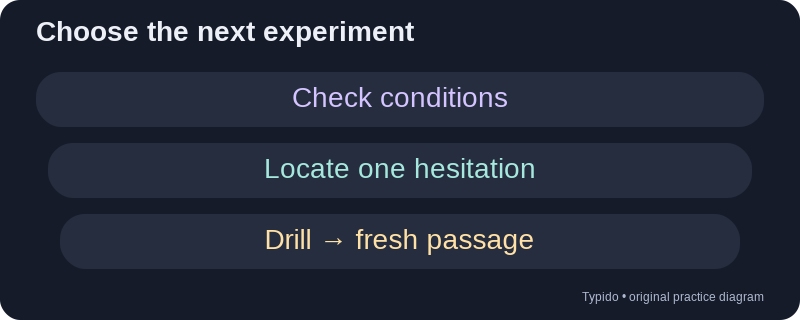
A week of similar scores can feel like a plateau, but the first question is whether the attempts were comparable. Next, look for a movement that remains uncertain. Repeating a full test can measure that uncertainty again without changing it. A useful response is a small investigation: check the conditions, identify a recurring interruption, practice it deliberately and return to fresh text under the original settings.
Check whether the plateau is actually one task
Review the duration, language, punctuation and keyboard for the attempts you are comparing. A harder passage or a different layout can hide an improvement in a particular movement. Conversely, a familiar passage can create a higher score without demonstrating a wider change. If the conditions vary, establish a simple baseline before concluding that your skill has stopped changing. Keep the comparison narrow enough that you can explain what stayed the same.
Record several ordinary attempts rather than only a personal best. Note interruptions and setup changes. A small range of results can be normal for a task, and one unusually high value may be a poor target for every later session. Choose your next practice from a recurring error or hesitation in those ordinary attempts.
Look for a pause that a single score hides
Notice when your attention leaves the next character. You might look down before a symbol, stop after a capital, hesitate between two letters or lose your place at a line break. Each of those suggests a different exercise. Select one that recurs on fresh text. “I need to type faster” does not identify a movement; “I stop before a question mark” gives you a practical place to begin.
Use a short passage and review it while the observation is still clear. Do not collect a long list of every possible weakness. If the interruption comes from reading an unfamiliar word rather than finding its keys, choose understandable text for the movement drill and keep reading practice separate. If a layout mismatch or input delay is involved, address the setup instead of asking your hands to compensate for a technical problem.
Choose the next experiment
- Speed stable, fewer corrections
- Keep the new control and compare another unfamiliar passage.
- Speed lower after changing keyboards
- Recheck layout and key positions before changing technique.
- Same hesitation on several days
- Reduce the task to that transition, then return to sentences.
Reduce the task until the transition is visible
Take the difficult transition out of the paragraph. For a capital followed by lowercase, practice a short word with that pattern. For a symbol, practice the preceding word and the symbol together. Move slowly enough that you can inspect the press, release and next reach. This is an observation exercise, so a temporary drop in speed is expected and does not invalidate the work.
After a few controlled repetitions, change the surrounding letters. If R after F is difficult, try “free”, “from” and a fresh phrase containing one of them. Then use the transition in a sentence you have not memorized. The exercise below is an original example, not a prescribed sequence for everyone. Replace the key pair with your own observed problem rather than copying a convenient drill that never challenges the interruption you identified.
fr rf free from
Fresh rain falls from the roof.
Bring a fresh folder from the front room.
Change one variable instead of the whole routine
If you change keyboard, duration, text type, layout and practice activity together, a later score will be difficult to interpret. Keep a stable baseline and vary one part of the exercise. You might add capitals while leaving duration and vocabulary similar, or extend from short phrases to sentences while keeping punctuation unchanged. The point is to make a result informative, not to create the most difficult possible session.
Use appearance customization to improve readability, but note a major change if it alters line breaks or how you track the source. Current typing appearance options in Typido are Free. A paid feature should not be presented as a guaranteed solution to a plateau. Choose a lesson because it practices the relevant movement and fits its actual access rules, not because a subscription label implies that improvement will happen automatically.
Include ordinary text after focused practice
A drill can become easy before the movement is dependable inside a sentence. After isolating the transition, copy new text that includes it alongside familiar keys. Watch whether the original pause returns. If it does, reduce the surrounding complexity and try a different example. If it does not, make another small change next time. This checks transfer without demanding a dramatic increase in the overall WPM number after every session.
A game can provide a different kind of keyboard attention, but it should not replace all fresh-text checking. A completed picture or a rhythm score follows its own rules. Keep those observations separate from standard timed WPM and accuracy. The useful connection is the movement you practiced, such as recognizing a letter without looking down, rather than a numerical conversion between a game’s points and the typing test.
Review control, comfort and purpose
Ask whether the same pace now involves fewer repeated errors, more reliable punctuation or less hesitation on a specific reach. Those observations can be meaningful even when a rounded WPM result stays similar. Also ask whether the task still serves your goal. If you mostly write with punctuation, a personal best on lowercase common words may be less useful than a steadier ordinary sentence with fewer corrections.
End or change the exercise when attention or comfort calls for a pause. Do not interpret a practice plateau as a health diagnosis, and do not continue an uncomfortable movement merely to complete a streak. Keep a short next-step note so the following session can start with a purpose. A well-reviewed session can be successful because it identified the right task, even when it did not produce a new best score.
Common questions
Should I double my practice time?
More time alone does not explain the problem. First verify the comparison and identify a recurring interruption. A smaller, reviewed exercise may be more useful than extending an unfocused or uncomfortable session.
Does a plateau mean I need a new keyboard or Pro?
Not necessarily. Check the actual setup and movement before buying anything. Paid lessons and equipment are not guarantees of improvement. Choose tools and activities for a specific observed need.