Practice setup
Plan short typing sessions with a clear stopping point
Plan a short typing session around one skill, a useful pause, and a fresh-text check. Leave yourself a clear next step.
A useful practice session is long enough to notice and work on a movement, but it does not need to become an endurance contest. A short session can contain a warm-up, one focused exercise and a clear review. This guide offers a flexible structure rather than a universal daily dose. Adapt it to your attention, comfort, schedule and any professional advice that applies to you.
Choose one task before you start the timer
Decide whether today’s purpose is learning a key, reducing a repeated mistake or checking a comparable baseline. Those purposes call for different activities. A timed test can reveal a pattern, but repeatedly testing without changing the practice may provide little explanation. Write one sentence naming the focus, such as “keep spaces between short phrases” or “release Shift after the first letter.” This makes it easier to judge whether the session was useful.
Pick an activity that fits that focus. Use a beginner lesson for an unfamiliar reach, a small original copying drill for a transition and a test for measurement. A game can provide variety, but its points should remain attached to its own rules. If the selected activity becomes a different challenge from the one you intended, pause and reconsider rather than continuing simply because the page is already open.
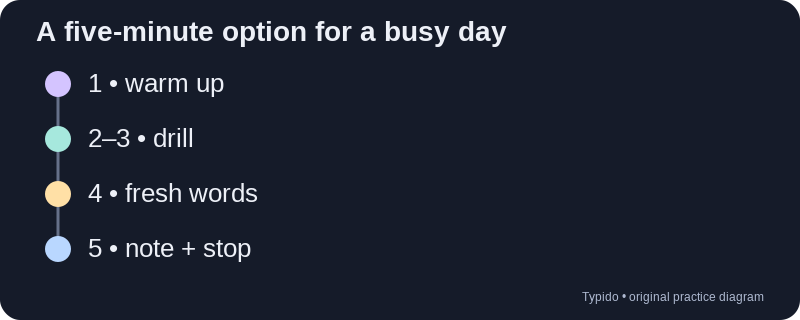
A five-minute option for a busy day
- Minute 1. Type a relaxed warm-up and choose one difficult transition.
- Minutes 2–3. Copy a small drill containing that transition.
- Minute 4. Pause, then use the transition in fresh words.
- Minute 5. Write one observation and stop.
Warm up without treating the first score as a verdict
Begin with a familiar, readable phrase and check your keyboard layout and display. The warm-up is a setup check, not a hidden assessment. If the keyboard or text settings have changed, note that before comparing anything with yesterday’s result. A short low-pressure attempt lets you discover a mismatched input setting or difficult reach without spending the rest of the session trying to explain an unusual first score.
Do not keep restarting until the warm-up produces a personal best. That changes the purpose from preparing to selecting the strongest attempt. If you want a baseline, choose the test conditions beforehand and record the ordinary result. An interruption can be noted rather than concealed. A useful practice record includes what happened, because that information helps you choose the next exercise and prevents a single number from carrying more meaning than it should.
Keep the focused exercise small enough to review
Use a short pair, word or sentence containing the movement you chose. Read it, enter it and compare the result. Name the difference before trying again. If the error is a missing space, work on the word boundary; if it is a neighboring key, check the reach. Practicing the entire paragraph repeatedly can make the specific cause difficult to see, especially when several unfamiliar characters appear together.
After a few controlled attempts, change the example while keeping the movement. Replace the noun, reorder the words or add one familiar punctuation mark. This checks whether the practice transfers beyond a memorized sequence. There is no requirement to complete a fixed number of repetitions. Continue only while you can still describe the task and inspect the result thoughtfully. The observation is more valuable than an arbitrary counter of completed lines.
Use a real pause rather than another score screen
Release the keys and step away from the text when you need a pause. Looking at a leaderboard or rapidly changing exercises can keep the same competitive pressure active. OSHA’s workstation guidance recommends changing position and varying computer tasks through the day; a well-arranged keyboard does not remove the need for movement and pauses. Use those general principles alongside any relevant advice for your own circumstances.
A pause is not a failure of practice. If you notice discomfort, stop the activity and reassess rather than trying to prove that you can finish a target duration. Persistent or concerning symptoms deserve appropriate professional advice. This article does not prescribe treatment or a medically validated training interval. For an ordinary practice routine, a clear stopping point helps you return with a useful plan instead of extending a distracted or uncomfortable attempt.
End with fresh text and one observation
If you are ready to continue, try a new short sentence containing the practiced movement. Check whether the same error returns. A good result on the original example followed by trouble on fresh text suggests that another small transition exercise may be useful. If both are controlled, the next session can add a little complexity. This review works even when there is no dramatic change in a timed speed score.
Write a brief note that another version of you could use tomorrow: “practice R after F in new words,” not just “do better.” Include the test settings if you measured WPM and accuracy. A small record avoids spending the next session rediscovering the same issue. It also makes it possible to see that accuracy or confidence in a particular movement changed, even if a best-score display does not highlight that progress.
Keep the routine flexible across busy days
On a day with little time, do the setup check and one focused example. On another day, add a lesson and a comparable test. You do not need to compensate for a missed session with an unusually long one. A streak can be a reminder, but it should not determine whether you continue when the task no longer feels useful. Keep practice connected to a controllable goal rather than treating every day as a test of commitment.
Typido’s learning library and blank practice record can help organize that goal without adding a new account or collecting exercise text. Guests can use the supported free activities, while saving account progress and opening paid material follow the current product rules. Check the relevant access description before choosing a lesson. A workable routine ends with a task you understand, a reviewed result and a sensible next step, rather than a promise of a fixed weekly WPM gain.
Common questions
How many minutes must I practice every day?
Choose a manageable session that lets you inspect the work, adapt it to your circumstances and stop when attention or comfort calls for a change.
Should I keep testing until my score increases?
Repeated attempts can vary without showing what changed. Choose a baseline in advance, practice one identified movement and check it on fresh text. Record the ordinary result instead of only the strongest attempt.