Planning practice
Keep a typing practice record that helps you choose the next task
Record comparable WPM, accuracy, and one useful observation. Read an example record and choose a focused follow-up session.
A list of scores becomes useful when it explains what you practiced and what to try next. You do not need a complicated spreadsheet or a public profile. A short offline record can capture the test conditions, the result and one movement worth reviewing. This guide shows what to record, how to avoid misleading comparisons and how to turn a weekly review into a practical decision.
Start with a question the record can answer
Choose a learning question such as “Are spaces becoming more dependable in one-minute sentence tests?” That question tells you which conditions to keep stable and which observation matters. A record that mixes every activity into one score column cannot answer it clearly. A game completion, a lesson result and a prose WPM test belong to different tasks. Keep their labels distinct rather than assuming that all higher numbers represent the same kind of progress.
Decide whether you are tracking a general test baseline or a specific exercise. You can keep both, but do not let one substitute for the other. A strong drill result on a memorized line may not transfer to fresh text. A timed baseline without any exercise notes may not explain why a score changed. The record should connect those pieces without pretending that it proves a guaranteed cause-and-effect relationship.
Record the conditions that affect comparison
Include date, test duration, passage settings, keyboard or layout changes, WPM and accuracy. Add an interruption note only when it helps interpret the attempt. You do not need to describe every detail of the room. Focus on changes that could make the task different, such as moving to a phone, enabling punctuation or using a longer test. A short consistent label is easier to review than several paragraphs of unstructured commentary.
Use a simple format in a text editor or print the blank record available from Typido’s learning library. It does not require a name or email and does not upload the entries. If you keep information about another person, follow the appropriate privacy process and collect only what is needed. For supervised learners, a private observation about a movement may be enough; a public list of names and scores is unnecessary for this practice method.
Write an observation that points to a drill
Replace a vague note such as “bad accuracy” with a difference you can act on. “Repeated R/F substitutions after an upper-row reach” suggests checking that reach and return. “Missing the space after short words” suggests practicing a boundary. Keep the note short enough to write immediately after the attempt. If you cannot identify the cause, record what you saw without claiming more certainty than the evidence supports.
Then write the next task in ordinary language: a few short pairs, two new words and a fresh sentence. This makes the record a starting point for the next session. Avoid adding so many goals that none can be reviewed. One clear movement is usually easier to investigate than an instruction to improve speed, accuracy, punctuation and every finger simultaneously. You can return to another pattern after learning something about the first.
Read an illustrative record without mistaking it for evidence
Imagine three fictional attempts under the same one-minute word-test settings. The first is 38 WPM at 94% accuracy, the next 42 WPM at 89%, and a later one 39 WPM at 97%. These numbers are invented solely to explain the method; they are not a testimonial, a research result or a promise about a real learner. The faster middle attempt also includes less accurate input.
A sensible note might be that pushing the pace brought back repeated errors, while a later controlled attempt was more accurate at a similar speed. That is a reason to inspect the movement and try fresh text, not proof of a particular training effect. More attempts and consistent conditions would provide additional context. Keep the distinction between an illustrative example and actual observed records explicit when sharing any practice guidance with others.
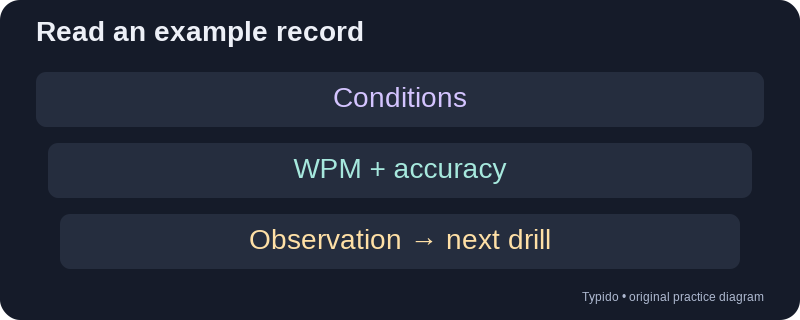
Read an example record
| Step or observation | Explanation |
|---|---|
| Attempt A | 38 WPM, 94% accuracy; repeated R/F substitutions. |
| Attempt B | 42 WPM, 89% accuracy; more corrections at the faster pace. |
| Next decision | Practice R/F slowly, then compare fresh text at a controlled pace. |
Review ordinary attempts rather than collecting personal bests
Choose in advance how you will record a baseline attempt so the log does not contain only your strongest results. If you retry after an interruption, note why. A personal best can be motivating, but it does not describe the whole range of a task. Look across comparable attempts for repeated errors and a pace you can maintain, rather than treating one unusually high value as a daily obligation.
When results differ, check the conditions before changing the training plan. New punctuation, unfamiliar vocabulary or a different keyboard can explain part of the difference. A small increase accompanied by less control may not serve the goal you chose. Conversely, maintaining speed with more dependable capitals can be useful. The record should preserve those observations instead of reducing every session to whether the largest number increased.
Use the weekly review to simplify the next session
At a convenient review point, read only the comparable entries and select one pattern that still occurs. Choose the relevant guide, lesson or short copying exercise. Keep the next task small and decide what fresh-text check will show whether it became easier. If the original problem is no longer obvious, choose a new focus rather than repeating the same drill indefinitely. A record is a tool for decisions, not an obligation to fill more rows.
Signed-in Typido accounts can save supported progress under the existing product rules, and Pro adds advanced progress charts and insights. Those features do not change the need to interpret the task. An offline record can remain useful whether you practice as a guest or with an account. Keep sensitive information out of exercise text and use real observations honestly. The best next step is the one the record makes understandable and practical.
Common questions
Do I need an account to keep a record?
No. You can use the blank offline record from the learning library in a text editor or on paper. Supported account history is a separate product feature and follows the current saving and access rules.
Are the example scores real user results?
No. They are explicitly fictional examples showing how to interpret a record. They do not establish a typical outcome, a testimonial or a guaranteed improvement from following this routine.