Planning practice
Use typing games, lessons and tests for different practice goals
Choose a typing lesson, game, or test for the skill you want to practice. Use a fresh-text check to see how the practice transfers.
A lesson teaches a movement, a game places keyboard input inside its own rules, and a typing test measures a defined transcription task. Each can be useful, but they are not interchangeable. A practical routine connects them through one skill you want to practice. This guide shows how to choose an activity, read its result and return to ordinary text without treating every point or completion as the same kind of progress.
Choose the activity from the difficulty you observe
If you are still searching for a key, a finger-placement lesson is a clearer starting point than a fast game scene. If you know the keys but repeatedly swap a pair, a short accuracy drill can isolate the transition. If you want to compare a general baseline, use a timed test under consistent conditions. Start with the task rather than opening whichever activity offers the largest or most exciting score display.
Write one focus in plain language, such as recognizing J without looking down or maintaining spaces between short words. Then ask whether the selected activity actually involves that movement. A game can be enjoyable while practicing a different kind of attention from the one you intended. That does not make it useless, but it is a reason to label the activity honestly and keep a more relevant exercise in the routine.
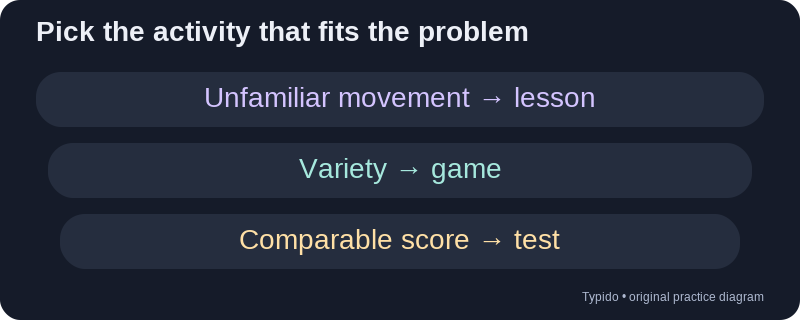
Pick the activity that fits the problem
- Finding unfamiliar keys
- Choose a guided lesson with a small key set.
- Wanting variety
- Choose a game, read its rules, and set a stopping point.
- Comparing WPM
- Use a timed test with the same settings as the previous check.
Use lessons when the movement itself is unfamiliar
A guided lesson can introduce a key, show a conventional finger position and place it into words. Follow a small group at a controlled pace, then test the movement in a different sentence. Do not rush through an unfamiliar reach solely to unlock the next screen. If you can describe what went wrong and correct it on fresh text, the exercise is giving you information that a completion indicator alone cannot supply.
Typido’s Beginner course is Free. Intermediate and all Advanced lessons, including their shortcut, number-pad and terminal-related material, require Pro under the current plan rules. Check those descriptions before assigning an activity to yourself or another learner. A subscription gives access to the included material; it is not a guarantee of a particular speed increase. Choose a lesson for its content and your next movement, not as a promised shortcut past practice.
Read the game rules before comparing attempts
Snakey, Gravix, Linkey, Funtype, Railo and Wordshot 3D have distinct objectives. A completed drawing, a cleared encounter, a movement challenge and a timed rhythm cue are different events. Read the game’s controls, difficulty and scoring guidance before playing. Compare attempts within the same activity and level when that comparison is useful. Moving to an unfamiliar scene can change the demand even if you use many of the same keys.
Check access and progression separately. A game or collection can be available on your plan while a later stage still requires earlier completion. Free starter access does not mean every level is Free. Read the selection screen rather than treating a lock as a broken link. The directory and individual guides link to the existing Free/Pro explanation so you can choose a suitable activity before beginning a session.
Connect play to a small ordinary-text exercise
After a letter-recognition activity, choose a new word containing a letter that made you look down. After a word-prompt activity, write a different sentence using a difficult transition. Use a blank document and fictional text. This checks whether the movement is becoming easier outside the game’s familiar sequence. You do not need to convert game points into WPM to make that connection useful.
For example, if R after F caused hesitation, try “fresh”, “from” and a new sentence such as “Fresh rain falls from the roof.” If a space caused trouble, practice a short phrase with clear word boundaries. These are original example exercises, not evidence of a measured training effect. Change the example after a few attempts and review the actual output instead of assuming that completing the game proves transfer to every text task.
Use tests for a comparable baseline
A standard timed test can measure correct-character WPM and attempted-input accuracy under its stated rules. Keep duration, text settings and device consistent when comparing attempts. A short burst of easy words differs from sustained copying with punctuation. Read the scoring explanation so a correction does not create confusion: a repaired final passage can still include earlier incorrect character attempts in the accuracy percentage.
Take an ordinary baseline before or after focused practice when it serves a purpose, not every time you want reassurance. A result can vary without revealing why. Record one movement observation alongside the score and use fresh text to check it. A Typido practice result is not automatically an employment certificate or a universal assessment of writing ability. Its value is in describing that task and helping you choose a sensible follow-up.
Build a sequence you can explain and repeat
A sample session might begin with a setup check, continue with a small lesson or drill, add a game attempt for variety and finish with a fresh sentence. On another day, use only the drill and the review. These are planning options, not a mandatory duration or a promise of improvement. Stop or change the activity when attention or comfort calls for a pause, and keep the next-step note brief enough to use later.
Review what each part contributed. Did the lesson clarify the reach? Did the game reveal a letter you still searched for? Did the new sentence show the same interruption? Those questions connect activity choice with observed work. Keep supported account saves, guest practice and game progression within their existing rules, and keep numerical results attached to the task that produced them. A useful routine is understandable even when it does not end with a new best score.
Common questions
Can game points be converted into WPM?
No shared conversion is claimed. Each game has its own rules and events. Use the standard timed test under comparable settings when you want to follow general correct-character WPM and attempted-input accuracy.
Do I need Pro to start?
The guest typing test, Beginner lessons and supported starter game content are Free. Intermediate, Advanced and specific premium modes or game levels require Pro. Check the current access page and the activity’s selection screen.