Accuracy exercises
Read ahead while typing without losing your place
Practice copying in manageable groups and tracking line breaks. Use fresh text to tell reading difficulties from keyboard hesitation.
Copying requires you to read the source, remember a small part of it and enter the corresponding characters. If you read too far ahead, you may skip a word; if you inspect only one character at a time, the task can feel fragmented. The useful amount of text to hold at once depends on the passage and your familiarity. Practice manageable groups rather than forcing a fixed number of words into memory.
Make the source understandable before increasing pace
Choose text in a language and vocabulary you can read. An unfamiliar term can create a pause before you even decide which keys to press. That pause is different from searching for a known letter. Begin with short familiar phrases when investigating keyboard movement, and reserve difficult vocabulary for a task where reading it is the actual goal. Otherwise a score may combine several challenges without showing which one caused the interruption.
Check source size, contrast and line width. If you repeatedly lose a line because the display is hard to follow, adjust the appearance before trying to type faster. Typido’s current appearance controls are Free. Note substantial display changes when comparing timed results, because different line breaks can change where you pause. A useful adjustment makes the task readable without silently changing the language or removing the characters you intended to practice.
Read a small group and check its boundary
Begin with one short phrase. Read it, enter it and identify where the following space belongs. Then look at the next group. You do not need to memorize an entire sentence. If you repeatedly skip the same kind of short word, slow the boundary and include that word deliberately. A copied sentence can still make sense after an omission, so check it against the source rather than relying only on whether it sounds plausible.
Use the original example below and divide it into groups that feel manageable. The slash marks in the planning line show possible reading groups; they are not characters to add to the actual sentence. After entering it, change the object or location and copy another version. This tests whether you can track a fresh sequence instead of recalling the order of one rehearsed sentence.
Planning groups: Bring the folder / to the small desk / beside the window.
Copy: Bring the folder to the small desk beside the window.
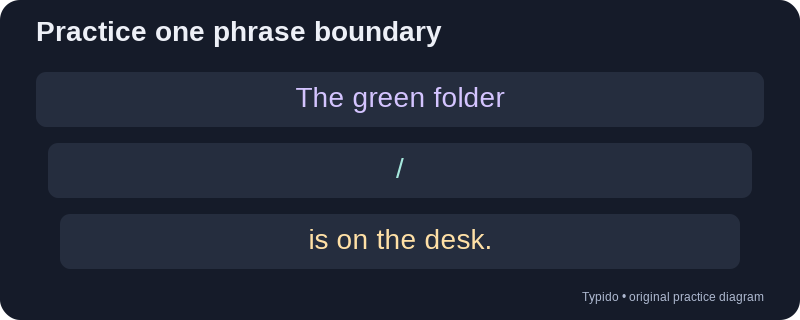
Practice one phrase boundary
- Read. Look at “The green folder” as a small meaningful group.
- Type. Copy the group without trying to hold the entire sentence in memory.
- Check. Verify the word ending and space before moving to “is on the desk.”
Treat line changes as transitions to practice
A visual line break can interrupt copying even when the words are familiar. Notice whether you repeat the last word of the previous line, skip the first word of the next or press Enter when the source only wraps automatically. Those are different errors. In ordinary prose, a wrapped display line is not always a new paragraph. Read the task instructions and preserve the intended text rather than adding a line ending solely because the screen wraps.
Practice with a short paragraph at a readable width. Identify the last group on one visual line and the first group on the next, then copy across the transition slowly. Do not change browser width between every attempt if you want to evaluate the same task. Later, use a different paragraph to see whether the tracking remains dependable. Keep the exercise about following the source, not memorizing a specific set of line positions.
Distinguish looking down from checking the source
A glance at the keyboard can be useful when diagnosing an unfamiliar key, but frequent searching can make it harder to keep your place in the source. Learn a small set of movements until you can locate them from the tactile references and use them in new words. If the interruption is mostly a particular symbol, isolate that reach instead of trying to eliminate every glance through a rule that encourages guessing.
Watch what happens just before an omitted word or repeated phrase. Did you search for a key, read an unfamiliar term or move your gaze to another window? Record the observable interruption without assuming a hidden cause. A shorter source group or clearer display may help one problem, while a finger-placement lesson helps another. The exercise should follow the observation rather than treating every lost place as a demand for more speed.
Use fresh text to check actual transfer
A memorized passage can feel smooth because you no longer need to read each group. That can be enjoyable practice, but it does not establish that you can track an unfamiliar passage equally well. After practicing a movement, choose new text with similar language, length and punctuation. Keep those conditions comparable while changing the word order. This gives you a more informative check than repeatedly selecting the passage you know best.
If performance changes, inspect the text before drawing a conclusion about your skill. More names, numbers or complex punctuation can add demands. A one-minute test and a longer sustained passage also differ. Note the conditions and one error pattern alongside WPM and accuracy. You are looking for a repeatable way to follow the source and enter it correctly, not proof that every new sentence must produce the same rounded score.
Combine reading groups with a deliberate review
Finish a short copying exercise by comparing the source and typed text. Check omissions, repeated words, spaces and sentence endings. Then choose one transition to repeat in a different sentence. If you are practicing ordinary writing rather than copying, evaluate the meaning of the finished sentence separately; composing introduces decisions about what to say. A pause for thinking is not automatically a keyboard defect.
Use the standard typing test for comparable transcription measurements and a focused lesson when an unfamiliar key causes the interruption. A game can vary the attention task, but following a target prompt is not identical to copying a paragraph. Keep those results separate. The practical goal is to make the next source group clear enough to enter deliberately, with a method for noticing when you lose your place and a small adjustment to try next time.
Common questions
How many words should I read ahead?
No fixed amount is prescribed. Use a manageable group that you can enter without skipping or guessing, then adjust it to the passage and your experience. Check the word boundary before moving to the next group.
Is a high score on a memorized passage misleading?
It describes that attempt, but it does not by itself show how you handle unfamiliar text. Use a new passage with comparable settings when you want to check whether the practiced movement and source tracking transfer.