Understanding scores
Average typing speed: what the CHI 2018 study found
See the CHI 2018 typing-speed benchmarks, how the study measured WPM, and why its results cannot establish average speed by age.
An age-based typing chart looks reassuringly precise. It seems to answer whether a child, student or adult is keeping up. But a WPM result depends on what was typed, how errors were treated, the keyboard and the people who took the test. Before judging yourself against a number, establish whether the comparison describes the same task. This guide shows how to make a useful comparison without turning an online average into a personal requirement.
An average needs a population and a task
An average from people who voluntarily visit a typing website describes those visitors. It does not automatically describe everyone of the same age. People who enjoy typing, own a physical keyboard or understand the test language may be more likely to participate. A classroom assessment can involve a different mix of learners. Even a large sample does not remove those differences. Look for the study population before treating its result as a normal score.
The research below supplies measured benchmarks with the task and sample attached. Use a learner’s own comparable attempts when setting a practice goal. Use it to understand a particular study, then keep the conditions of your own test consistent.
What the CHI study actually reports
Dhakal and colleagues retained 168,960 self-selected volunteers who transcribed 15 English sentences. WPM used five-character words and the interval between the first and last keypress. These are sentence-transcription results, not composing or workplace performance. [Dhakal et al., Methods, pp. 3–4]
Table 1 describes the 168,960 retained volunteers who completed the 15-sentence English transcription task and demographic questionnaire: their self-reported ages had a mean of 24.5 years and SD of 11.2 years; 75% were aged 11–30. These are questionnaire demographics, not typing-speed measurements for those ages. The paper does not publish WPM means for separate age bands, so no age-band speeds have been read off a graph or estimated here. [Dhakal et al., Table 1, p. 3]
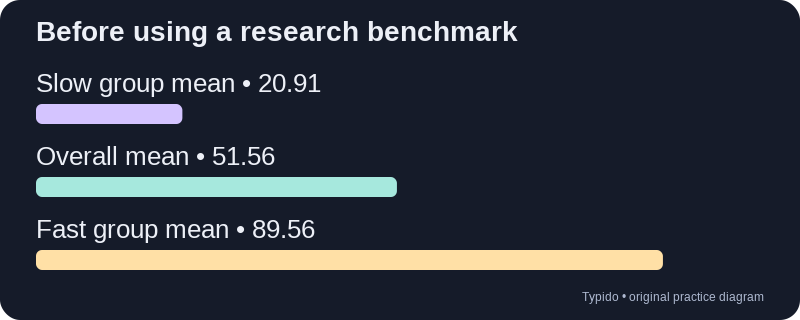
Read the following as study benchmarks across the reported ages. The fast and slow groups were selected by speed, not age. Their means cannot be relabeled as teenager, adult or older-adult averages, or used to claim that training caused a particular gain.
Scroll the table horizontally to read the methods and sources.
| Reported statistic | WPM | Sample, task and method | Source |
|---|---|---|---|
| Overall mean and standard deviation | Mean 51.56; SD 20.20 | All 168,960 retained self-selected volunteers. Task: transcribe 15 English sentences. Method: sentence length in five-character words divided by minutes between first and last keypress, then averaged per participant. This is not an age-band result. | Table 3, p. 5; Methods, pp. 3–4 |
| Fast-group mean | 89.56 | Fastest 10% (above approximately 78 WPM) of the 168,960 retained self-selected volunteers; the paper does not state a separate subgroup count here. Task: transcribe 15 English sentences. Method: sentence length in five-character words divided by minutes between first and last keypress, then averaged per participant. This is not an age group. | Table 3, p. 5; group definitions and method, p. 4 |
| Slow-group mean | 20.91 | Slowest 10% (below approximately 26 WPM) of the 168,960 retained self-selected volunteers; the paper does not state a separate subgroup count here. Task: transcribe 15 English sentences. Method: sentence length in five-character words divided by minutes between first and last keypress, then averaged per participant. This is not an age group. | Table 3, p. 5; group definitions and method, p. 4 |
Before using a research benchmark
- Population. Identify who volunteered and who was retained after exclusions.
- Task. Separate copying English sentences from composing your own text.
- Grouping. Check whether a group is defined by speed or by age.
Compare children and beginners with their own starting point
For a learner who is still locating letters, a timed paragraph mixes keyboard familiarity with reading and copying. A longer word may take time to understand before any key is pressed. Start with whether the learner can find a small group of keys, return to a comfortable position and enter a short familiar word. Those observations tell an adult what to teach next. A comparison with an experienced teenager usually does not.
Try a simple activity away from the timer: locate F and J, type a few short words, then copy one new sentence. Notice where attention goes. Looking down for every letter calls for key recognition practice; losing the position in the sentence calls for a shorter passage or a clearer display. Keep feedback specific and private. On Typido, under-18 learners should use guest access in line with the published age policy, with appropriate adult supervision.
Account for experience rather than assuming age explains everything
Two adults of the same age may have very different typing histories. One may enter text every day; another may mostly use a phone. A familiar laptop, a different national layout or a newly purchased keyboard can change the task again. Age alone cannot tell you which movement is causing a pause. Ask what the person has practiced and which device they normally use before deciding that a result is unexpectedly low.
If you are returning to a physical keyboard after a long break, record a comfortable baseline and choose one recurring difficulty. Perhaps capitals interrupt your rhythm, or punctuation is difficult to locate. A focused improvement in that movement is useful even if your score does not resemble an online age chart. Avoid interpreting a practice result as a judgment about intelligence, work ability or health. It describes an attempt under particular conditions.
Make the next test genuinely comparable
Use the same duration, language, keyboard layout and passage settings when checking progress. Compare a one-minute prose test with another one-minute prose test, not with a thirty-second burst of easy words. Include the same punctuation and number settings. Keep correction rules consistent, because a test that allows editing can produce a different result from one that stops at every wrong key. Write these conditions alongside the score rather than relying on memory.
Typido calculates WPM from correct characters in the current typed text, using five characters per standardized word and elapsed minutes. Accuracy tracks correct character-input attempts out of all character-input attempts. Backspace can improve the finished passage without erasing an earlier incorrect attempt. Read both values together. A faster result accompanied by many more mistakes can suggest that the next practice session should emphasize control rather than another attempt to raise the speed number.
Use a personal range instead of one best result
Record several ordinary attempts over separate practice days. Keep a brief note about an interruption, unfamiliar keyboard or unusually difficult passage. You can then see whether a score was typical of that task or an isolated best. You do not need to calculate a sophisticated percentile. A small, honest record is more informative than selecting your strongest attempt and comparing it with someone else’s average on a different website.
Choose a process goal for the next session: fewer repeated I/O substitutions, more deliberate spaces or a steadier use of Shift. Retest after practicing that exact skill in fresh sentences. If a score varies, review the conditions before changing the goal. Improvement can also mean maintaining similar speed with fewer errors or completing a longer passage without losing your place. These are observations you can act on regardless of your age.
Turn a comparison into a practical session
Begin with a short warm-up, take one baseline test and stop to read the result. Choose a single mistake pattern and write an original sentence containing it. For example, if spaces disappear when you hurry, copy “Bring the small blue folder to the front desk.” Check each word boundary, then change the sentence. This makes the practice about transferring a movement rather than memorizing the test text.
Finish with another comparable attempt only if you still feel comfortable and attentive. Record what you tried, not just whether the number rose. Next time, repeat the conditions and decide whether the same problem needs another short drill. Use the typing test for measurement, the beginner lessons for unfamiliar keys and a game for variety. None of those activities requires you to reach an invented age norm before your practice counts as worthwhile.
Common questions
Is there one correct WPM for my age?
No single figure here is presented as an age requirement. A meaningful comparison needs a defined population, task, device and scoring method. Your repeatable baseline is a better starting point for choosing practice.
Should a child keep repeating timed tests?
Use short, supervised activities suited to the learner. Key recognition, comfortable movement and accurate familiar words can be more informative than repeated speed attempts. Keep feedback about the task rather than ranking children publicly.
Sources and further reading
- Dhakal et al., CHI 2018: Methods and Table 1, pp. 3–4
The retained cohort, English sentence-transcription procedure, demographic questionnaire and scoring definition are documented here. The age statistics describe participants, not speed norms by age.
- Dhakal et al., CHI 2018: Table 3, p. 5
This is the direct source for the exact overall and speed-group WPM figures reproduced above. Speed-selected groups must not be presented as age bands; no missing age-band value has been estimated.
- Research project and paper details