Learning the keyboard
Home-row typing practice that carries over to real words
Use home-row anchors, varied key pairs and original sentence drills. Learn when to add a reach, how to check mistakes and how to move beyond memorized patterns.
Home-row practice gives your hands a reference point, but endless rows of the same letters can become a memory exercise. To make the practice useful, alternate locating the keys, entering short combinations and applying them in a new order. The exercises here assume US QWERTY. Copy them into a blank document at your own pace; they are examples for independent practice, not passages automatically loaded into Typido’s test.
Know what the starting position is doing
The F and J tactile marks found on many keyboards help you establish where your index fingers are. Neighboring home-row positions provide a predictable starting area for other fingers. You do not need to press every home key or hold your hands perfectly still. Think of the position as a place you can recognize again after a movement. Its usefulness is in reducing uncertainty about where the next reach begins.
Before copying a pattern, find the reference points and type one key from each hand. Check the output. Lift the hands and repeat. If the characters shift consistently to neighboring keys, fix the placement first. A longer exercise will otherwise repeat a starting-position error. This small check is particularly useful after moving from a laptop to a separate keyboard, where the physical spacing or keyboard location may feel unfamiliar.
Change the order so the task remains about keys
Begin with a few alternating keys such as F and J, then change their order. Mix a single key, a short pair and a pause. If you always repeat the same sequence, you may learn its rhythm without recognizing a different sequence containing those letters. Check the intended character before pressing it. It is acceptable to slow down or briefly inspect the keyboard when diagnosing a mistake.
The first example below is deliberately short. Read one group, enter it and compare the result before moving to the next. After a few accurate groups, replace one letter with another home-row key. You are testing whether the hand remains oriented when the order changes. Do not turn the example into a long endurance challenge: stop while you can still explain which movement was easy and which was uncertain.
fj jf ff jj
dk kd df jk
as sa al la
Put the keys into words and spaces
Words make you connect the small movements in an order you did not choose for convenience. With a limited home-row set, the vocabulary will also be limited, so use a few ordinary words rather than inventing meaningless paragraphs. Include spaces deliberately. Read the completed phrase and check whether the letters and word boundaries match. A correct key pattern followed by a missing space is a different issue from choosing the wrong letter.
Try the example below, then rearrange the words into a different short phrase. If a word consistently causes a pause, isolate its troublesome pair once or twice and return to the phrase. Avoid spending the whole session on a word that has already become automatic. The useful next task is a fresh combination using the same movement, so you can see whether it remains dependable outside the original example.
a sad lad
a flask falls
ask a lass
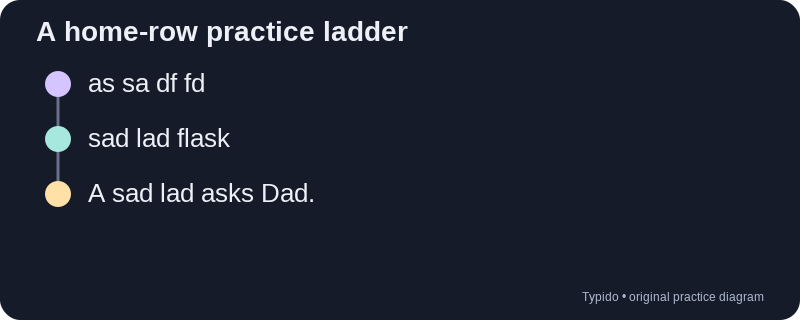
A home-row practice ladder
- Patterns. Copy “as sa df fd” once while watching the text.
- Words. Copy “sad lad flask” with a clear space between words.
- Sentence. Copy “A sad lad asks Dad.” including the capital and period.
- Review. Choose one difficult transition before repeating the ladder.
Add one reach without abandoning the anchor
Home-row knowledge becomes practical when it supports movement to other rows. Choose one new target and practice going from a familiar key to the target and back. For instance, F-R-F checks an upper-row return. Do not add a full row of new keys at once if you can no longer tell which movement caused an error. Keep enough known material in the exercise that the new reach is easy to recognize.
After practicing the reach, write a short new sentence that uses it. For R, a sentence such as “A red jar falls.” combines the new target with several familiar movements. Check the whole phrase, including its capital and punctuation if those movements are already known. If they are not, start with lowercase words and add those features later. The aim is a progression you can understand, not a prescribed order that ignores what you already know.
Review the pattern instead of only counting errors
A single total does not tell you whether the hand shifted, two letters swapped order or a word boundary disappeared. After each short example, name the mistake. You might write “J became K after lifting my hand” or “the last letter of the word was repeated.” That description leads to a specific practice decision. Simply repeating the whole exercise faster often makes the cause harder to observe.
Compare a corrected attempt with an unfamiliar phrase containing the same keys. If the first improves but the second does not, reduce the task and practice the transition more deliberately. Typido’s attempted-input accuracy includes earlier incorrect character attempts even when you edit the passage afterward. Use that explanation when reading a test result; do not assume a clean finished line must produce perfect accuracy. The correction and the original attempt are separate information.
Decide when to move beyond the home row
You do not need a perfect score or a universal WPM target before learning another key. Look for enough control that you can find the anchors again and type a fresh short combination without guessing every movement. Then add one useful reach. If progress becomes confusing, return briefly to the reference position and identify the first unreliable transition. This gives you a concrete adjustment rather than a vague instruction to practice more.
Finish with a small real-world task: type a made-up note, label a fictional folder or copy one new sentence. Keep the keyboard and layout consistent for a while. A beginner lesson can provide the next group of keys, and a game can add variety, but do not replace all ordinary text practice with points. Home-row drills have done their job when they help you enter varied text with a clearer sense of where your hands are.
Common questions
Should I stay on home-row drills until I am fast?
Use them to learn orientation and controlled transitions. Add a small new reach when the existing group is understandable, then use it in fresh words. Speed on a memorized pattern alone is not a complete progress check.
Can I use these exercises on a phone?
They are designed for physical-keyboard positioning. A touch keyboard has different movement and correction behavior, so its results should not be treated as a comparable home-row or physical-keyboard speed assessment.